Episode 1: Prologue: Modern Threats and the "Paradox of History"
A visual depicting modern, ultra-futuristic Chinese skyscrapers (Shanghai, Shenzhen) anchored by golden circuit diagrams and pipelines originating from the Japanese archipelago, symbolizing capital and technology transfers. Dark clouds hover over the East China Sea separating the two confronting nations.
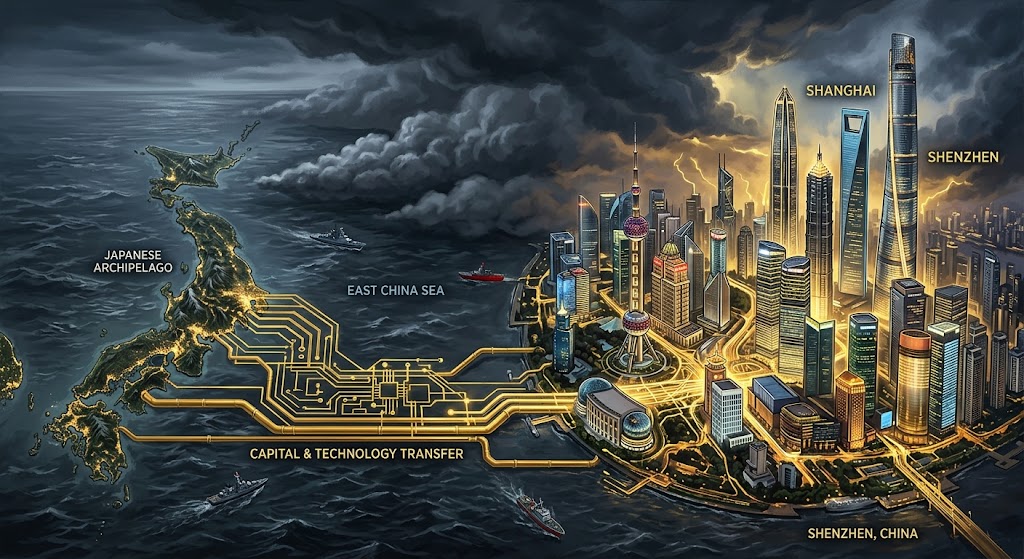
Why Did the Neighbor We Generously Supported Become Our Greatest Risk?
Incursions into the waters around the Senkaku Islands, mounting tension across the Taiwan Strait, aggressive technological encirclement, and economic coercion—day after day, headlines report the assertive diplomatic and military stance of China, leaving many with deep anxiety and unanswered questions.
“How did China become such a formidable, dominant superpower?”
Many attribute this solely to the Chinese Communist Party's (CCP) authoritarian trajectory and its 1.4 billion population power. However, a meticulous review of historical facts reveals a bitter "Paradox of History."
The structural foundation of today’s mighty People's Republic of China—its military, technological, industrial, infrastructure, and cultural pillars—was deeply built upon massive amounts of capital, technology, talent, and operational know-how injected by Japanese public and private sectors from the immediate post-WWII era into the modern day.
The Rocket Engine Provided by Japan
Immediately after Japan's defeat in 1945, Japanese technical personnel detained or remaining in the chaos of northeastern China built the foundations of the PLA Air Force and medical services from scratch. In the 1970s and 80s, Japanese industrial titans, believing that "China's modernization is essential for Asian peace," transferred state-of-the-art factories and technologies wholesale. Furthermore, Japan’s Official Development Assistance (ODA), which began in 1979, totaled ¥3.66 trillion, constructing airports, ports, and railways that enabled China’s economic takeoff.
What Japan injected served as the high-powered rocket engine propelling China to become the world’s second-largest economy.
What Lay Beyond "Engagement": A Cold Reality
At that time, Japan and Western nations shared a common expectation:
"As China grows prosperous, it will naturally liberalize and democratize politically, becoming a cooperative superpower that abides by international rules."
This was the core belief of the "Engagement Policy." But how did it unfold?
Instead of directing its newfound economic muscle toward democratization, the CCP funneled it into strengthening its one-party rule and executing an explosive military buildup. Today, Japan finds itself on the front lines of this military and economic threat.
This 10-part series avoids emotional rhetoric or one-sided condemnation. By examining structural factors—including Japan’s own miscalculations and the strategic decisions made by its government and corporations—we will uncover the historical truth.
Understanding our past decisions and lessons with objective clarity is the essential first step to navigating the treacherous geopolitical landscape ahead.
-
Next Episode:
Next time, we journey back to the immediate aftermath of WWII in 1945. We explore the little-known story of Captain Yaichiro Hayashi and other former Imperial Japanese Army aviators who built the CCP’s air force from zero.
-
References & Primary Sources:
-
Akio Yaita, The Trap of the Chinese Communist Party (WAC)
-
Toshiya Tsugami, China’s Brain: The Intellect Driving a Giant Nation (Nikkei Publishing)
-
Episode 2: The Post-WWII Chaos: The Japanese Who Supported the CCP Army
A sepia-toned illustration of a Type 99 Advanced Trainer aircraft (Clover) with a former Japanese Army flight commander explaining flight mechanics to young, attentive Chinese cadets on an airfield in Manchuria.

The "Father" of the PLA Air Force Was Japanese
In August 1945, right after the end of the Pacific War, the CCP's forces (later the People's Liberation Army) in Manchuria faced a brutal reality: they lacked modern military technology and had virtually zero air power.
Rescuing them from this predicament was a unit of roughly 300 Japanese personnel led by Major Yaichiro Hayashi, former commander of the Imperial Japanese Army’s 54th Flight Regiment.
Upon Hayashi's surrender, CCP officials (including future Premier Zhou Enlai and General Wu Xiuquan) offered "lenient treatment" and earnestly requested Hayashi's cooperation in establishing a military aviation school and training their cadres.
The Miracle of the Northeast Democratic United Army Aviation School
In 1946, the Northeast Democratic United Army Aviation School was established in Tonghua, with Yaichiro Hayashi serving as Chief of Staff (effectively head of education). He oversaw the maintenance and flight instruction using abandoned Japanese aircraft like the Type 99 trainer.
-
Training Under Extreme Conditions: When gasoline was scarce, they adapted alcohol as fuel, built runways from scratch, and strictly instilled flight safety protocols.
-
Cultivating Air Force Leadership: Hayashi and his team trained roughly 160 Chinese pilots. These men later engaged US forces in the Korean War and rose to top leadership positions, including Commanders of the PLAAF.
Even in official PLA historical records, the contributions of Hayashi and his Japanese colleagues are explicitly honored as the "foundational pillars of the Chinese Air Force."
Medical, Railway, and Steel Specialists Remaining in China
The aviation sector was not alone. Tens of thousands of Japanese specialists—doctors, nurses, railway engineers, and steel technicians—remained in post-war China and were integrated into the CCP’s organizational machine.
-
Field Hospital Medical Networks: Former Japanese military doctors and nurses taught sanitation, trauma surgery, and hospital management, drastically reducing mortality rates among CCP troops.
-
Railway Restoration: Engineers from the South Manchuria Railway Company swiftly repaired rail networks destroyed during the Chinese Civil War, preserving crucial supply lines for the CCP.
"Without the direct technical assistance of these Japanese specialists, the CCP’s victory over the Nationalists (KMT) and the founding of the PRC would have been delayed by years."
As many historians point out, this early transfer of Japanese expertise provided foundational support for the very birth of the Communist regime.
-
Next Episode:
Next time, we look into psychological warfare and cultural origins: the anti-war campaigns in Yan'an and the Japanese creators who laid the groundwork for Chinese animation and cinema.
-
References & Primary Sources:
-
Yaichiro Hayashi, Until the Day the Phoenix Soars: Records of Founding the Chinese Air Force (Nippon TV)
-
Norimasa Kamiya, Japanese Soldiers Who Joined the Eighth Route Army (Iwanami Shoten)
-
Episode 3: Psychological Warfare & Cultural Origins: Yan'an and Man-Ei
A split-composition illustration: On the left, a Japanese soldier under moonlight addressing his former comrades via loudspeaker on the front lines; on the right, a Japanese animator inspecting cell frames under a lamp in an animation studio.

The Success of Anti-Japanese Psychological Warfare in Yan'an
During the Second Sino-Japanese War, the CCP base in Yan'an, Shaanxi Province, conducted sophisticated psychological warfare aimed at dismantling the morale of the Imperial Japanese Army.
At the center of this strategy was Sanzō Nosaka (Okano Susumu), a senior leader of the Japanese Communist Party residing in China, who established the Japanese People's Emancipation League (Anti-War Alliance).
In the 1940s, Japanese prisoners of war (POWs) captured by the Eighth Route Army underwent humane treatment coupled with intense ideological re-education. Converted Japanese POWs joined the Anti-War Alliance and went directly to the front lines to conduct psychological operations against Japanese troops.
-
Loudspeaker Campaigns: Infiltrating near enemy trenches at night, singing Japanese nostalgic songs before appealing through loudspeakers: "Don't throw your life away—return home alive."
-
Comfort Bag Operations: Inserting leaflets exposing humane POW treatment inside cigarette packs and comfort kits dropped near Japanese lines.
This campaign caused widespread demoralization, leading to a steady stream of desertions and surrenders. The CCP perfected the art of psychological warfare by utilizing Japanese personnel to persuade Japanese soldiers.
How "Man-Ei" Built the Foundation of Chinese Animation and Film
Concurrently, Japanese expertise reshaped China’s state propaganda and cultural industries.
The infrastructure and equipment of the state-backed Manchukuo Film Association (Man-Ei) were seized after the war, becoming the Northeast Film Studio (later Changchun Film Studio). Remaining Japanese technical staff provided comprehensive instruction in cinematography, editing, and sound engineering.
A prominent figure in this transition was Tadahito Mochinaga (Chinese name: Fang Ming), a pioneer who laid the cornerstone for Chinese animation.
-
Producing China's First Puppet Animations: At the CCP's request, Mochinaga directed China's early puppet animation films, including The Emperor's Dream and A Turtle in a Jar.
-
Laying the Foundation for Shanghai Animation Film Studio: The Chinese animators trained under Mochinaga went on to establish the renowned Shanghai Animation Film Studio, creating classics like Havoc in Heaven (Sun Wukong).
The Synergy of Propaganda and Culture
Psychological operations combined with visual storytelling techniques transferred from Japan yielded potent propaganda tools that enabled the CCP to consolidate public support and project legitimacy domestically and internationally.
While many individual Japanese contributors acted out of goodwill or personal passion, the structural result was the fortification of the CCP's ideological machinery.
-
Next Episode:
We leap forward to 1978. Paramount leader Deng Xiaoping visits Japan. What were his candid impressions aboard the Shinkansen and inside Japanese automated factories?
-
References & Primary Sources:
-
Tadahito Mochinaga, Genealogy of Frame-by-Frame Animation (Ghibli Library)
-
Masahiro Watanabe, The CCP and Japanese POWs (Yoshikawa Kobunkan)
-
Episode 4: Deng Xiaoping’s 1978 Visit to Japan: The Catalyst for Modernization
The iconic silhouette of Deng Xiaoping gazing intently out the window of a Shinkansen "Hikari" train traveling at 200 km/h, with dynamic motion blur highlighting the technological gap between the two nations.
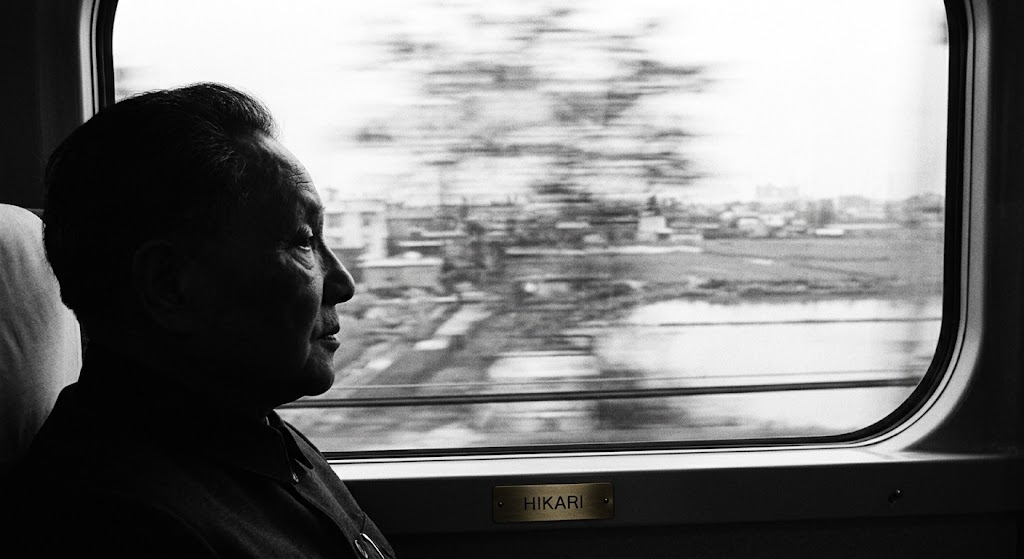
The First Official Visit by a Top Chinese Leader
On October 22, 1978, a pivotal moment in history occurred: Vice Premier Deng Xiaoping, China's paramount leader, arrived in Japan for the exchange of ratifications for the Treaty of Peace and Friendship between Japan and China. It was the first official visit by a top CCP leader to Japan.
At the time, China was emerging from the chaos of the Cultural Revolution (1966–1976). Its economy was devastated, and its population endured extreme poverty.
Determined to witness Japan's post-war "economic miracle" firsthand, Deng embarked on an intensive 8-day tour of Japan’s most advanced industrial sites.
A Revealing Remark Aboard the Shinkansen "Hikari"
On October 26, while riding the Tokaido Shinkansen "Hikari" from Tokyo to Kansai, a Japanese journalist asked Deng for his impressions. In China, where steam locomotives averaged tens of kilometers per hour, a train traveling at over 200 km/h was unimaginable.
Deng replied without hesitation:
"It feels like riding the wind. It feels as if someone is whipping us from behind. Speed is precisely what we need right now."
This was no mere admiration for a high-speed train; it was a raw admission of his acute anxiety over how far China had fallen behind and an urgent declaration that China had to modernize at all costs.
Confronting the Massive Productivity Gap at Nissan
The following day, Deng visited Nissan's Zama Plant, where robotic arms were performing automated welding—a state-of-the-art facility at the time.
When informed that the plant produced 94 vehicles per worker annually, Deng was stunned. At China's largest auto plant in Changchun, annual productivity was a mere 0.6 vehicles per worker.
Faced with a 150-fold productivity gap, Deng remarked quietly at the end of his tour:
"Now I truly understand what 'modernization' means."
The Catalyst for "Reform and Opening-Up"
Deng's experiences in Japan reshaped global history.
Just two months later, in December 1978, at the historic 3rd Plenary Session of the 11th Central Committee, Deng officially abandoned Maoist class struggle in favor of market-oriented economic policies: "Reform and Opening-Up" (改革開放).
The breathtaking technology and efficiency Deng witnessed in Japan served as the primary catalyst for his decisive pivot, setting China on its path toward explosive economic growth.
-
Next Episode:
Next time, we explore how titans of Japanese industry—Konosuke Matsushita and Nippon Steel's Yoshihiro Inayama—responded directly to Deng’s appeals by transferring critical technology and manufacturing systems to China.
-
References & Primary Sources:
-
Ryuji Hattori, Sino-Japanese Normalization: Kakuei Tanaka, Masayoshi Ohira, and the Bureaucratic Challenge (Chuko Shinsho)
-
Ling Xingguang, Deng Xiaoping and Japan (Asahi Shimbun Publishing)
-
Episode 5: Private Sector Passion: Konosuke Matsushita and Nippon Steel's Bold Moves
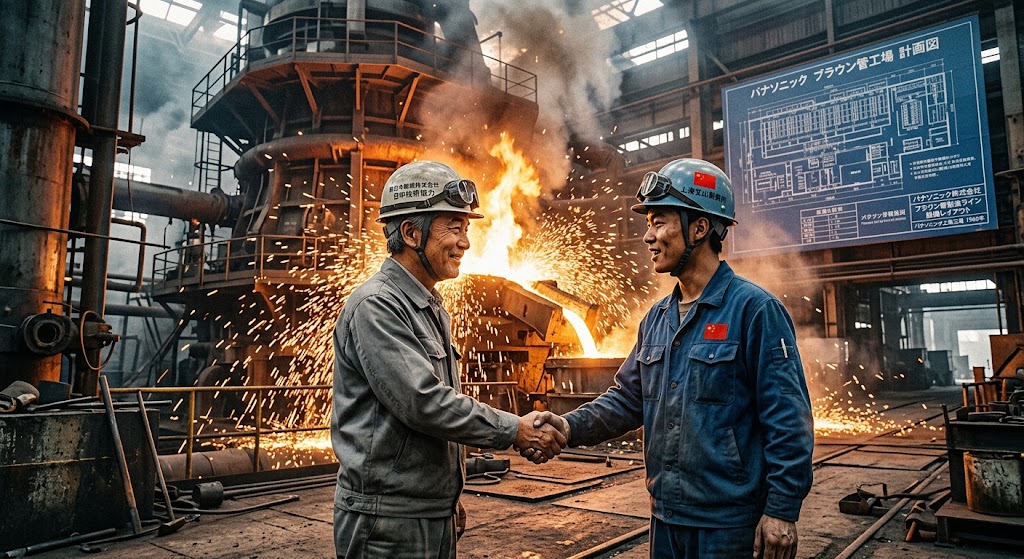
Japanese master engineers and young Chinese technicians shaking hands in front of the fiery blast furnace of the Baoshan Steel Plant in Shanghai, overlaid with blueprints of Panasonic’s cathode-ray tube (CRT) factory.
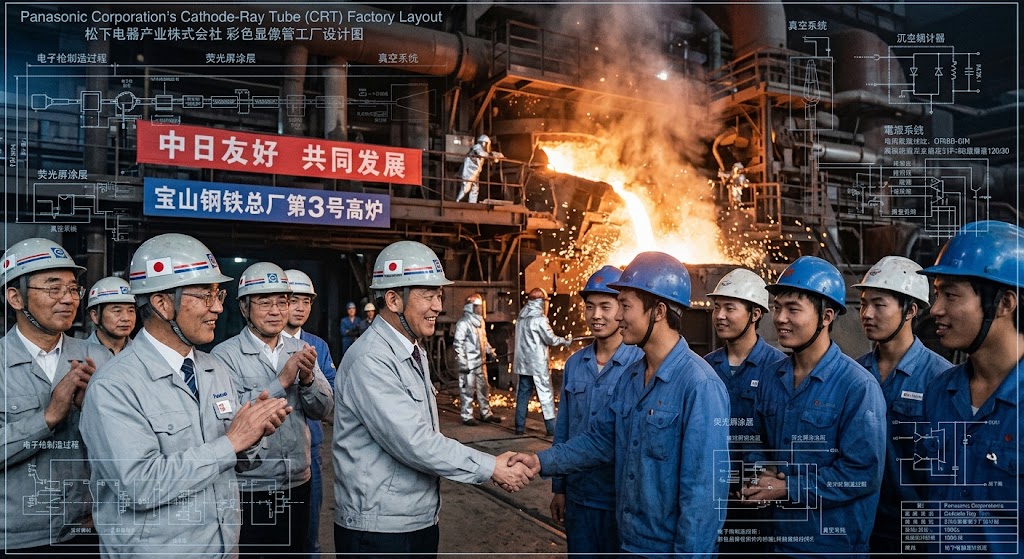
Deng Xiaoping Appeals to the "God of Management"
During his 1978 visit, Deng Xiaoping toured Panasonic's (then Matsushita Electric) Ibaraki plant in Osaka, where he was greeted by founder Konosuke Matsushita, widely revered as the "God of Management."
After observing automated production lines for microwave ovens and color televisions, Deng held Matsushita's hand firmly and made an earnest appeal:
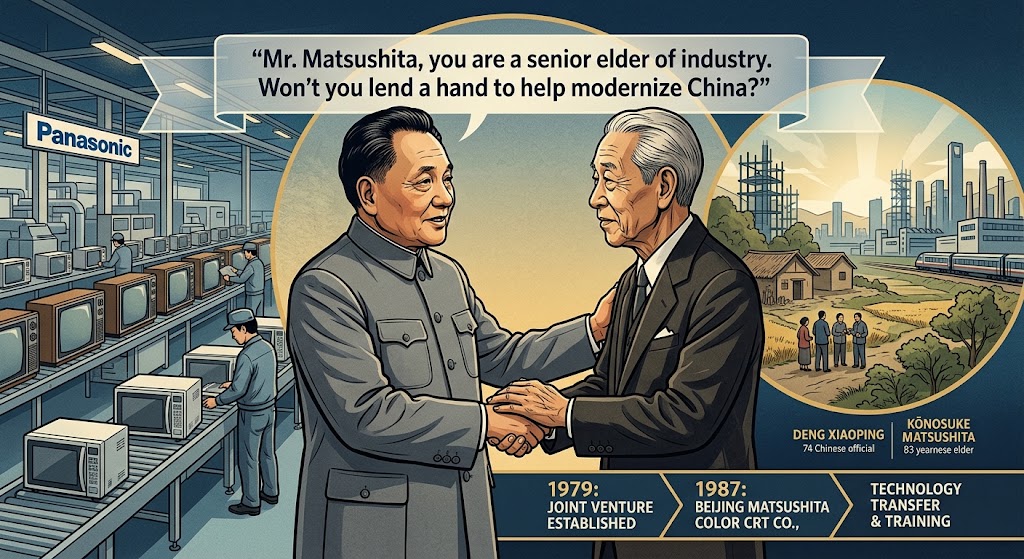
The 83-year-old Matsushita readily agreed. Visiting China in 1979 and 1980 to meet with Deng again, Matsushita established Beijing Matsushita Color CRT Co. in 1987—China's landmark Sino-foreign joint venture in electronics.
Panasonic did not merely build a factory; it systematically trained Chinese staff in Japanese work ethics, Total Quality Control (TQC), and 5S operational standards, providing the foundational template for China’s electronics industry.
Baoshan Steel Works: Transplanting Modern Heavy Industry
Deng made a similar personal appeal to Yoshihiro Inayama, Chairman of Nippon Steel. Impressed by the automated efficiency of Nippon Steel's Kimitsu Works, Deng requested an identical modern steel complex in China.
This gave birth to the Shanghai Baoshan Iron and Steel Plant project—the crown jewel of China’s industrial modernization.
| Area of Support | Specific Contributions |
| Design & Facilities | Direct transfer of Nippon Steel's latest plant designs and heavy equipment. |
| On-Site Guidance | Thousands of Japanese engineers dispatched to Shanghai to supervise construction and startup operations. |
| Talent Cultivation | Chinese technicians and plant managers hosted in Japan for long-term operational training. |
Despite domestic skepticism over the immense financial cost and technical complexity, persistent instruction by Japanese engineers led to the successful ignition of Baoshan’s First Blast Furnace in 1985. Securing domestic high-grade steel paved the way for the rapid expansion of China’s automotive, shipbuilding, and construction industries.
A Bet Placed on Goodwill and Regional Stability
Why did Japanese corporations undertake such high-risk, large-scale technology transfers?
Beyond economic motivations like offsetting the strong yen, there was a genuine conviction that a prosperous, stable China was essential for peace and stability across Asia.
A complex blend of post-war atonement and confidence in Japan's economic model drove private-sector leaders to build China’s industrial backbone from the ground up.
-
Next Episode:
Next time, we examine the massive influx of Japanese taxpayer funds through Official Development Assistance (ODA)—totaling ¥3.66 trillion—that financed China’s national infrastructure.
-
References & Primary Sources:
-
Konosuke Matsushita, My View on Management (PHP Institute)
-
Nippon Steel Corporation, 30-Year History of Nippon Steel (Nippon Steel)
-
Episode 6: ¥3.66 Trillion in ODA: Building China’s Core Infrastructure
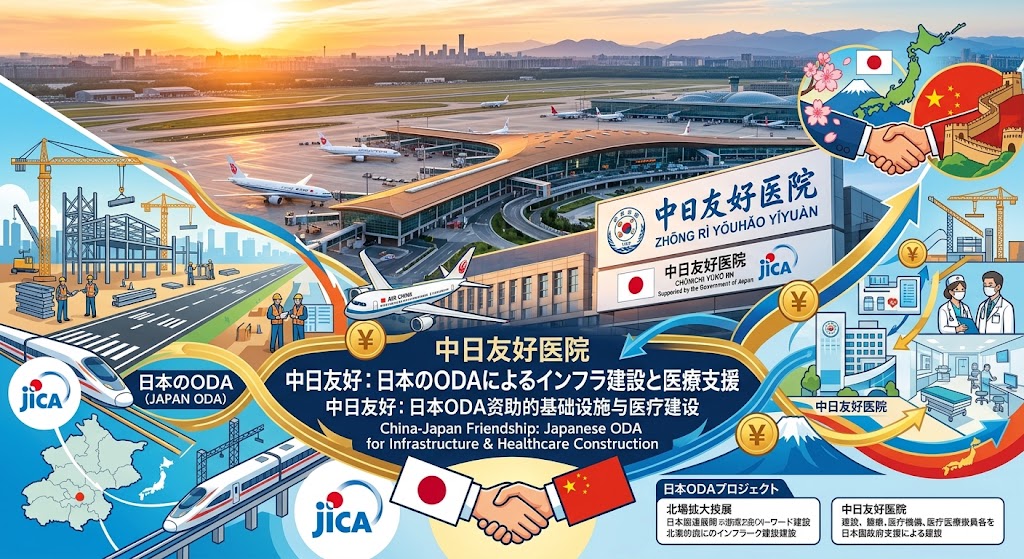
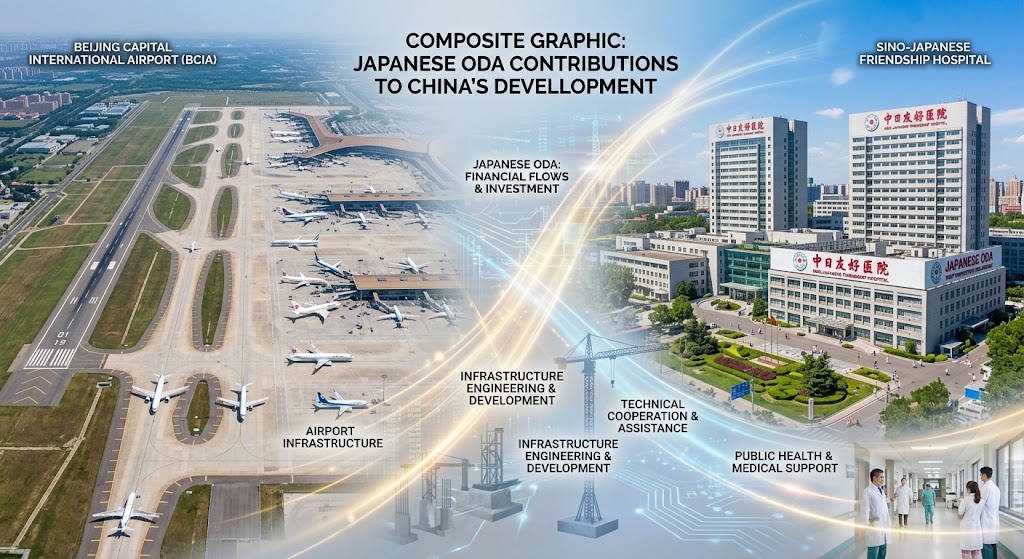
A composite graphic showing Beijing Capital International Airport's modern runways and the Sino-Japanese Friendship Hospital, with a soft overlay representing Japanese ODA financial flows and infrastructure engineering.
Prime Minister Masayoshi Ohira’s Landmark Decision
In December 1979, Japanese Prime Minister Masayoshi Ohira visited Beijing and announced the commencement of Japan’s Official Development Assistance (ODA) to China.
Exiting the Cultural Revolution, China lacked foreign currency reserves and international credit standing. The Japanese government stepped in with low-interest, long-term yen loans, channeling massive public capital into China.
From 1979 until its final conclusion in 2022, Japan’s ODA to China totaled approximately ¥3.66 trillion.
Constructing the Backbone of Modern China
Japanese ODA funded critical physical infrastructure across China:
-
Strategic Port Expansion: Construction of major deep-water berths at Qinhuangdao Port and Qingdao Port to facilitate coal exports and maritime trade.
-
Railway Electrification: Double-tracking and electrification of key lines like the Beijing–Qinhuangdao Railway to move inland natural resources to coastal ports.
-
Aviation Hubs: Construction of passenger terminals at Beijing Capital International Airport and funding for Shanghai Pudong International Airport.
-
Urban Transit and Energy: Funding for the Beijing Subway system, as well as hydroelectric and thermal power plants nationwide.
The industrial infrastructure—ports, airports, power grids, and transit networks—that allowed global corporations to set up factories and export goods from coastal China was largely constructed using Japanese tax dollars.
Medical and Environmental Technical Assistance
Beyond heavy infrastructure, grant aid and technical cooperation built key healthcare and environmental institutions:
【Key Institutions Built via Japanese ODA】
  ├ Sino-Japanese Friendship Hospital (Beijing): Opened in 1984 with state-of-the-art medical equipment and Japanese clinical instruction.
  └ Sino-Japanese Center for Environmental Protection (Beijing): Established in 1996 to transfer air pollution mitigation and PM2.5 monitoring technology.
The Sino-Japanese Friendship Hospital served as a primary medical center during the 2003 SARS outbreak, saving countless lives.
Serving as a Shield After Tiananmen Square (1989)
Following the military crackdown on democratic protesters in Tiananmen Square in June 1989, Western nations imposed swift economic sanctions, isolating China internationally.
However, the Japanese government concluded that isolating China would derail its economic reforms and push it toward extremism. In 1990, Japan became the first G7 nation to resume yen loans, acting as a bridge to re-integrate China into the international community.
Japanese ODA functioned not merely as financial aid, but as a geopolitical buffer that stabilized the CCP regime during one of its most vulnerable moments.
-
Next Episode:
Next time, we analyze the unintended consequences: China's transformation into the "Factory of the World" while Japan suffered industrial hollowing out and three "Lost Decades."
-
References & Primary Sources:
-
Ministry of Foreign Affairs of Japan, Evaluation Report on Japan’s ODA to China
-
Naotaka Oki, The 40-Year Trajectory of ODA to China (Akashi Shoten)
-
Episode 7: The "Factory of the World" and Japan’s "Lost Decades"
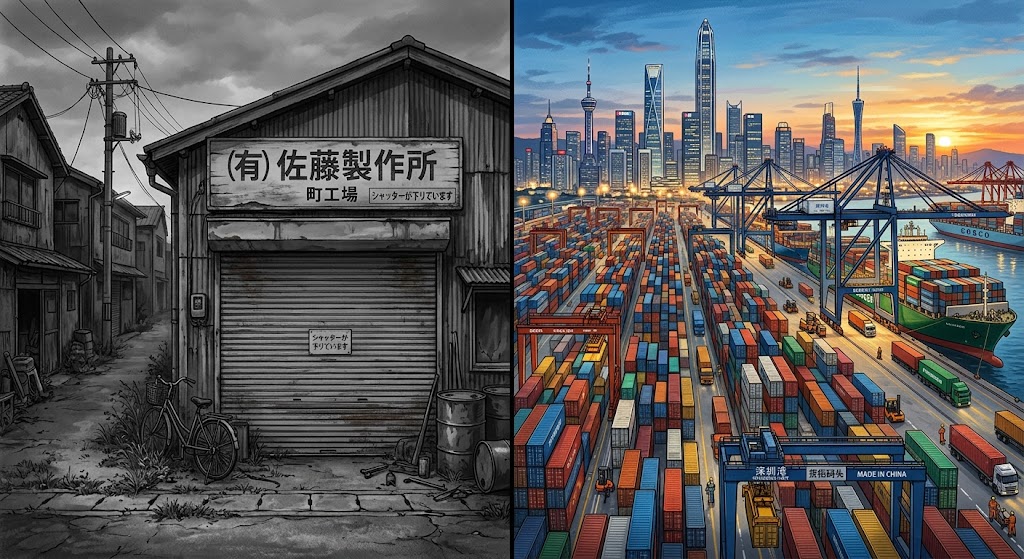
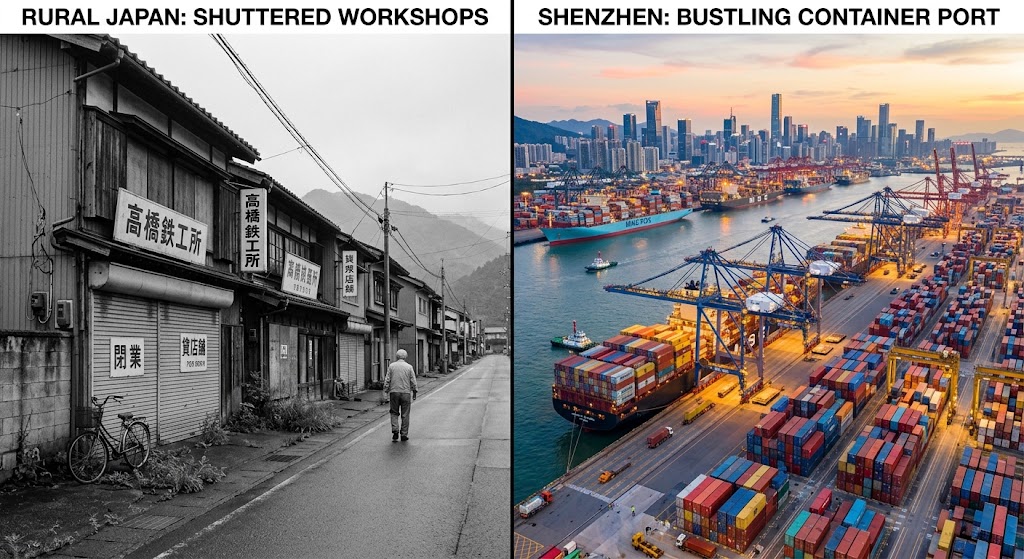
A stark visual contrast: On the left, shuttered small-scale manufacturing shops in rural Japan in monochrome; on the right, vibrant, bustling container ports in Shenzhen packed with cargo ships in full color.
The Exodus Driven by the Strong Yen and Deflation
Following the 1985 Plaza Accord, Japan experienced a sharp appreciation of the yen. The burst of the economic bubble in the early 1990s pushed Japan into a prolonged period of structural deflation.
Faced with unsustainable domestic manufacturing costs, Japanese companies across electronics, automotive components, precision machinery, and textiles shifted production en masse to coastal China (Shenzhen, Guangzhou, Shanghai, Dalian).
This shift triggered a dramatic reversal of economic momentum between the two neighbors.
How China Absorbed Advanced Manufacturing Ecosystems
When Japanese firms established operations in China, they brought along entire supply networks:
-
Transfer of Component Networks: Japanese die-and-mold makers and parts suppliers relocated alongside primary manufacturers, establishing comprehensive local supply chains.
-
Absorbing Process Engineering: On-site instruction by veteran Japanese engineers systematically transferred high-precision manufacturing know-how to local Chinese technicians and managers.
Consequently, China acquired advanced manufacturing ecosystems in a fraction of the time it would have taken independently, rapidly becoming the undisputed "Factory of the World."
Industrial Hollowing Out and Delayed Structural Reform in Japan
Meanwhile, Japan faced severe domestic repercussions:
| Nation | Structural Shifts & Consequences |
| Japan | Factory relocations led to domestic industrial hollowing out, stagnant wages, and lagging digital/software transformation during the "Lost Decades." |
| China | Leveraged imported manufacturing platforms to leapfrog into next-generation industries like EVs, drones, and commercial hardware. |
While China offered short-term cost savings, over-reliance on offshore manufacturing hollowed out Japan's domestic industrial base and eroded its long-term growth capacity.
Furthermore, easy profits generated in the growing Chinese market led Japanese corporate management to postpone necessary domestic restructuring and software-driven innovation.
A Dramatic Reversal of Fortunes
In 1990, Japan’s GDP was nearly eight times larger than China’s. Today, that ratio has inverted, with China’s economy expanding to roughly four times the size of Japan's.
While China used Japanese capital and technology to propel itself to second place globally, Japan endured 30 years of economic stagnation—a heavy price paid for prioritizing short-term cost reductions over long-term strategic positioning.
-
Next Episode:
Next time, we examine why the West failed to anticipate China’s current trajectory: the collapse of the "Engagement Policy" and the fatal miscalculation that economic wealth would bring political liberalization.
-
References & Primary Sources:
-
Kiyoshi Kojima, Direct Investment and Industrial Hollowing Out (Toyo Keizai Shinposha)
-
Hiroshi Yoshikawa, Deflation: Japan’s Choice (Nikkei Publishing)
-
Episode 8: The Failure of "Engagement Policy": The West's Fatal Miscalculation
An illustration showing a rising stock market chart backdrop from which the ominous shadows of high-tech surveillance cameras, facial recognition grids, and military tanks emerge.

The Illusion of "Commercial Peace Theory"
Why did Japan and Western democracies extend such extensive support to the Chinese Communist Party, even facilitating its accession to the World Trade Organization (WTO) in 2001?
Throughout the 1990s and 2000s, Western policymakers adhered to a widely accepted premise:
The Core Premise of "Engagement Policy":
As China integrates into market capitalism and its citizens grow wealthy, a expanding middle class will demand political freedom and democracy. Economic interdependence will naturally transform China into a "Responsible Stakeholder" within the rules-based international order.
This economic determinism served as the primary justification for continuous capital, technology, and trade concessions to Beijing.
The CCP’s Real Strategy: State Capitalism and Civil-Military Fusion
However, historical outcomes directly contradicted Western expectations. The CCP channeled the wealth and technology derived from global trade into fortifying one-party rule and expanding its military capacity:
-
Digital Authoritarianism:
Deploying AI, facial recognition, and pervasive network monitoring to construct a high-tech surveillance state that suppresses political dissent.
-
Civil-Military Fusion (軍民融合):
Mandating that dual-use commercial technologies acquired from foreign firms (AI, telecommunications, shipbuilding, aerospace) be directly integrated into PLA military modernization.
-
Unilateral Assertion of Power:
Converting economic leverage into geopolitical force through artificial island construction in the South China Sea, frequent maritime incursions into the East China Sea, and intensified military pressure on Taiwan.
Nurturing a Geopolitical Rival
Former US official Michael Pillsbury admitted in The Hundred-Year Marathon that Western nations miscalculated Beijing's long-term ambitions.
The CCP's overarching goal was never to assimilate quietly into a Western-led liberal order, but to achieve the "Great Rejuvenation of the Chinese Nation" and re-establish regional and global dominance under party control.
Japan's post-war assistance unwittingly served as a convenient stepping stone for the CCP to achieve these strategic objectives. By the time Western democracies recognized the failure of engagement, China had already developed into a formidable economic and military power.
-
Next Episode:
Next time, we examine how historical assistance has been eclipsed in modern diplomacy, replaced by aggressive legal and propaganda tactics like the invocation of the "Enemy State Clauses."
-
References & Primary Sources:
-
Michael Pillsbury, The Hundred-Year Marathon: China's Secret Strategy to Replace America as the Global Superpower (Henry Holt and Co.)
-
Ryosei Kokubun, Chinese Politics and Sino-Japanese Relations (Iwanami Shoten)
-
Episode 9: Forgotten Gratitude and the "Enemy State Clauses" Card
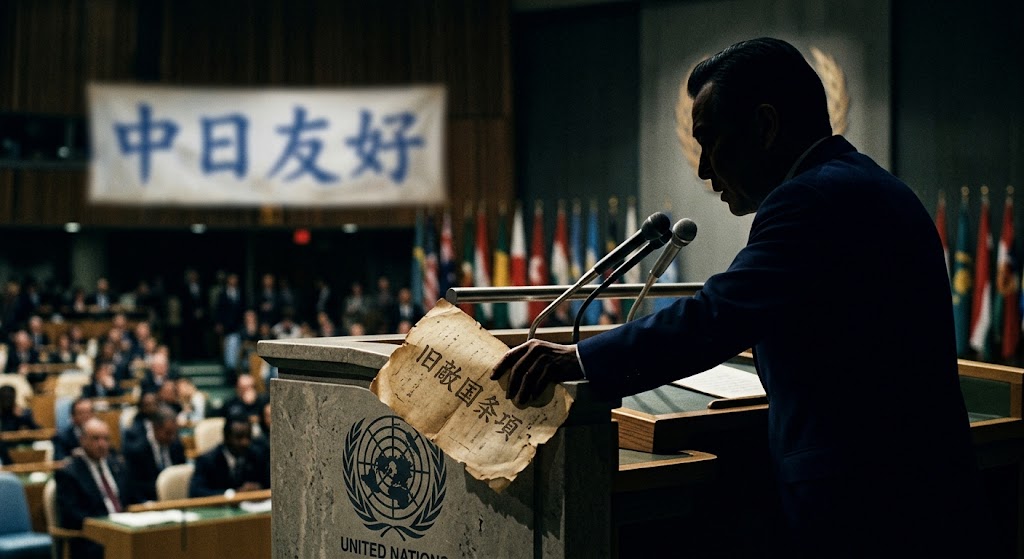
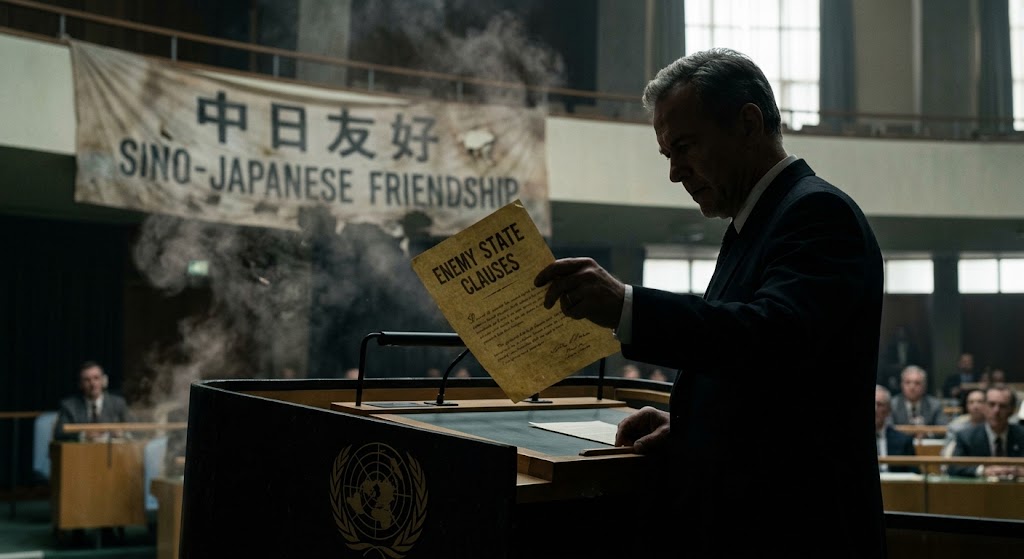
The shadow of a diplomat at a UN podium holding out a yellowed document labeled "Enemy State Clauses" as a diplomatic card, while a faded banner reading "Sino-Japanese Friendship" dissolves in the background.
The Erasure of Past Support from Public Memory
In earlier decades, Chinese leaders like Mao Zedong, Zhou Enlai, and Deng Xiaoping publicly acknowledged Japanese economic and technical assistance. As late as 2007, Premier Wen Jiabao stated before the Japanese Diet that the Chinese people "sincerely appreciate and will not forget" Japan’s ODA.
Today, however, public memory of Japanese development assistance has been largely erased from textbooks, museums, and state media in China.
Under state-sponsored patriotic education campaigns initiated in the 1990s, official historical narratives have focused overwhelmingly on Japan’s wartime aggression and the CCP’s role in defeating foreign invaders, omitting post-war Japanese aid entirely.
Weaponizing the UN "Enemy State Clauses"
Beyond the erasure of past assistance, historical grievances are actively weaponized in modern diplomatic and legal maneuvering.
A prime example is Beijing’s recurring reference to the "Enemy State Clauses" (Articles 53, 107, and 77) of the United Nations Charter.
What Are the "Enemy State Clauses"?
Provisions in the UN Charter drafted in 1945 that referenced WWII "enemy states" (such as Japan and Germany). While rendered obsolete by UN General Assembly resolutions in 1995, the clauses formally remain in the Charter text.
Whenever Japan moves to increase its defense budget, acquire counterstrike capabilities, or deepen alliance coordination, Chinese diplomatic mouthpieces invoke these obsolete clauses alongside the Cairo Declaration to frame Japan’s actions as:
-
"Attempts to challenge the post-WWII international order."
-
"A resurgence of right-wing militarism that violates historical commitments."
The Strategic Intent Behind the Narrative
The diplomatic objectives behind invoking these historical narratives are clear:
-
Undermining Japan’s Defense Legitimacy: Depicting Japan’s defensive posture as inherently dangerous to divert international scrutiny from China’s own military expansion.
-
Reinforcing Domestic Regime Legitimacy: Framing the CCP as the sole defender of national sovereignty against external threats.
-
Blocking International Reform: Countering Japan’s bids for a permanent seat on the UN Security Council.
Expecting historical gratitude to temper modern geopolitical rivalry misunderstands authoritarian statecraft. In foreign policy, perceived strategic interest consistently overrides past goodwill.
-
Next Episode:
In the final episode, we turn to the diplomatic strategy of Prime Minister Sanae Takaichi's cabinet—shifting from naive engagement to realistic deterrence, economic security, and strategic indispensability.
-
References & Primary Sources:
-
Junji Abe, The UN Charter and the Enemy State Clauses (Yushindo Kobunsha)
-
Zhu Jianrong, China’s Japan Policy and Nationalism (Sobunsha)
-
Episode 10: Epilogue: The Takaichi Cabinet's Realism and Japan’s Path Forward
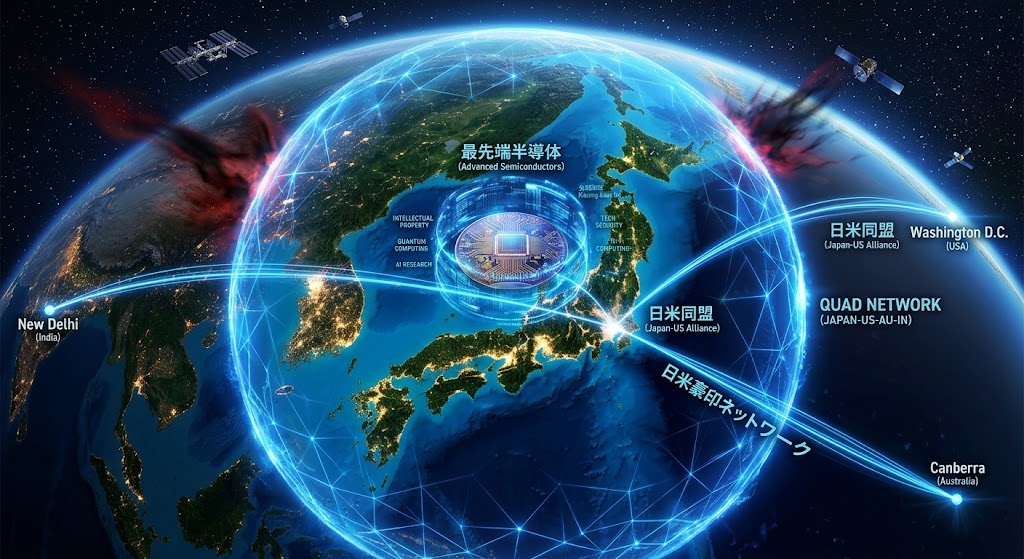
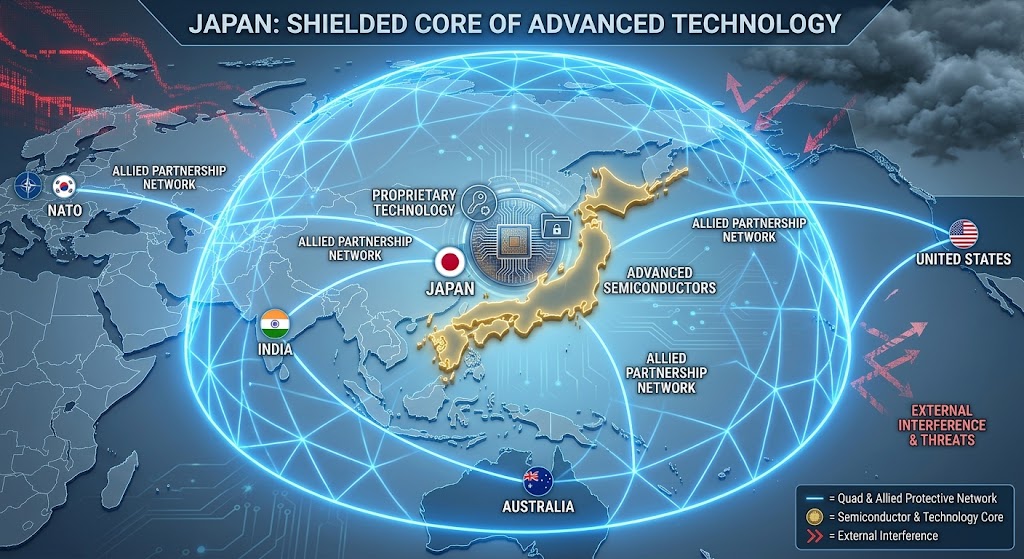
A map centered on Japan with blue protective network lines linking Quad and allied partners, shielding a central core of advanced semiconductor wafers and proprietary technology from external interference.
A Complete Break from Naive Engagement
In this final episode, we examine Japan’s current diplomatic and security posture.
The strategic direction pursued by Prime Minister Sanae Takaichi's cabinet represents a fundamental departure from past engagement policies. It reflects a cold-eyed realism built on the hard lessons of the post-war era.
Recognizing that economic prosperity alone will not alter the CCP’s political trajectories, Japan has shifted toward a framework grounded in deterrence, technological sovereignty, and international law.
Three Pillars for Japan’s Long-Term Security
To maintain stability alongside a powerful neighbor, Japan’s strategic posture focuses on three core pillars:
1. Economic Security and "De-risking"
While total economic decoupling is impractical, "de-risking" vital supply chains is essential. Through the full implementation of the Economic Security Promotion Act and security clearance systems, Japan strictly guards dual-use technologies, advanced semiconductor equipment, and intellectual property from unauthorized transfer.
2. Maintaining "Strategic Indispensability" (戦略的不可欠性)
Deterrence requires ensuring that pressuring Japan carries severe costs to a rival’s own domestic industries. Japan continues to invest heavily in critical niches where its technology remains irreplaceable—such as specialized semiconductor materials, advanced manufacturing equipment, and high-performance chemical compounds.
3. Strengthening Deterrence and Multilateral Networks
To balance power dynamics in the Indo-Pacific, Japan is enhancing its self-defense capabilities—including counterstrike capabilities and island defense—while strengthening the U.S.-Japan Alliance and deepening cooperation with Quad partners (US, Australia, India), South Korea, NATO, and European allies.
Transforming Lessons into Strategic Strength
The primary lesson of the post-war Sino-Japanese relationship is clear: in international relations, diplomatic strategies based on unreciprocated goodwill or assumed gratitude are unsustainable.
The historical paradox—where Japanese capital and technology inadvertently bolstered the power now challenging its security—serves as a cautionary guide for future policy.
Navigating this reality requires clear-eyed analysis rather than nostalgia. By combining robust defense deterrence, rigorous economic security, and irreplaceable technological strength, Japan can effectively safeguard its sovereignty and contribute to long-term stability across the Indo-Pacific.
-
Concluding Note:
Thank you for reading this 10-part series. We invite you to share these articles to foster informed discussion on history, geopolitics, and Japan’s strategic future.
-
References & Primary Sources:
-
Sanae Takaichi, Toward a Beautiful, Strong, and Growing Nation (Fujimi Salon)
-
Nobukatsu Kanehara, What Is National Security? (Shincho Shinsho)
-